Arnica Salve for back and joint pain

So, as many of you that know me know, I do LOTS of other projects.  From rebuilding a Volkswagen to making herbal teas.  Well, here is the latest one.  I am making a balm/salve for muscles and joints.
The idea is to make something stronger and better than Tiger Balm and others like it.  I have been tinkering with it for a while.  Here is the first steps.  I had to make the base...
The most common base has either bees wax or petroleum.  I didn't want to use any animal products or petroleum (basically a by product of crude oil)... bleech!
I did some research and really tried many different things including almond oil, coconut oil, vegetable glycerin, different alcohols, and even trying to get some bees wax.  I felt badly that I was taking from bees needlessly and so looked all over for alternatives.
Here is what I found.  A really good wax called Candelila (which comes from a shrub) can be used in place of petroleum.  It is a very hard wax though and has to be cut with something to give it a better feel and smoother texture.  Also has to be somewhat easy to absorb into the skin without being irritating in any way.   I got a hold of some Shea Butter which has great properties, is very stable and quite nice for and on the skin.


[gallery ids="204,203,202,200,199,201,197" type="rectangular"]
I had to experiment on what to do in regards to the amounts of each in the formula.  I was looking for a similar texture to Tiger Balm or Siddhalepa (one I found in Sri Lanka).
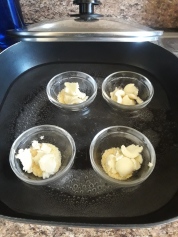
Here was the process:   I had to melt the candelila wax in a double boiler as to not burn the wax.  I used a hot plate and an old pot I had for herb preparations I made.
The first picture of the table has all the ingredients I was working with.  (I will post them in detail later) .  I have the oil/wax mixture in the small Plexiglas ramekins I got at the local 'chef' store.  I just had to keep mindful of which one was which.  Once they all melted together I set them aside to cool and set.  I had not added any of the active ingredients yet.
[gallery ids="205,206,207" type="rectangular"]
As I was able to melt everything together I had to keep really good notes.  I was able to find a great ratio of wax to Shea Butter and have it all set for the next step.  Adding the chemicals and oils for the therapeutic effect.
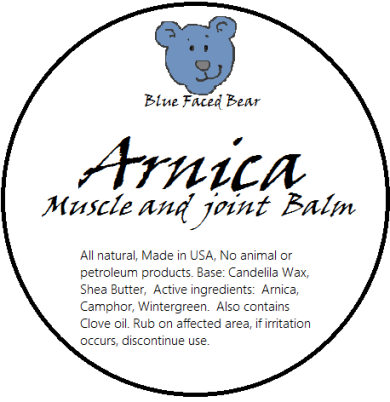
So I had to come up with the labeling.  What a chore that was.  I was trying to get too much information on the little round 1.5" labels.  I ended up using Microsoft's Paint application and was able to design the logo (The Blue Faced Bear) and the vital information.   I found a printer that would get me the labels rather cheaply.  I will post them in the next installment.  But here is the new logo as well as a sample label.

[gallery ids="208,209,210,198" type="rectangular"]
The ingredient ratios:  (this is from notes of 2/25/2019)
All are Essential Processed oils:  Mostly from CCS, LLC * (Consolidated Chemical and Solvents
Arnica 4 parts, 4 ounces or 8 tablespoons
Mentholatum* (Methyl Salicylate) 2 parts, 2 ounces or 4 tablespoons
Camphor 2 parts, 2 ounces or 4 tablespoons
Pinene* 1 part; 1 ounce or 2 tablespoons
clove oil 1 part... 1 ounce or 2 tablespoons
 (total of 10 parts for easy measuring) 

Wax (Candelita) 1 parts= 5 oz. (10 tablespoons)
Oil (Shea Butter) 3 parts =15 oz.  (30 tablespoons)

The first set was 30 finished items:
Tins, labels, tape to close each one, printed directions and small bag to hold it.  

Label details:  This is from Sellercentral.amazon.com 
  1. Drugs must be labeled in English with the following information:
    1. The title of the drug
    2. The “Drug Facts” panel
    3. The active ingredient(s)
    4. The purpose(s) of the drug
    5. The use(s) of the drug
    6. Any required warning(s)
    7. The directions for using the drug
    8. Any other information, as required for the specific product
    9. The inactive ingredients
  2. Drug must use the claim “FDA approved” appropriately
  3. Drug labels must not use the FDA logo
I will be altering some of the info and also putting in a piece of paper explaining more about the product.   Later I will be adding a couple different formulas to the mix.  The end plan is to have three.
I will make an initial batch of about 30 and give them away for people to try and to rate.
So there you go.
Another project.  Catch me for more later this month.

Dr. Sean

OK< New ideas: 
Blue Bear Salve:  (This is the Arnica) 4 parts arnica, 2 parts menthol, 2 parts camphor, 1 part pinene, 1 part clove oil.  
Red Rhino penetrating medicated oil (see Red Flower) 6 parts methyl salicylate, 3 parts cinnamon, Draco resin 1 part, (in Safflower oil)
Yellow Elephant?? (See Siddhalepa) (3 parts eucalyptus, 2 part citronella, 1 part cinnamon, 1 part pinene, 1 part camphor, 1 part menthol) 
Green Dragon, or Shark???  (Tiger Balm) (7 part Eucalyptus, 5 Part Cinnamon, 5 Part Clove, 10 Parts Camphor, 9 parts Menthol) 

Individual CHEMICALS Needed: 
Methyl Salicylate (Have about 900 ml)
Arnica Oil (Have about 100 ml) PRAAN
Camphor Oil (FROM A POWDER CCS)
Pinene (have about 900 ml) CCS
Clove oil (PRAAN)
Draco (Dragons Blood Resin)
Eucalyptus
Citronella (PRAAN)
Cinnamon (PRAAN
(almost all are available at Praan Naturals (https://www.praannaturals.com/downloads/default.asp)
Chemicals are available at (https://www.consolidated-chemical.com/)

BASES
Safflower Oil
Candelilla wax
Shea Butter

All ‘scripts’ can be found on our blog:  https://thenaturalbodyworks.blogspot.com


Phone: 720- 325 9886
Address:  12539 N. Highway 83, Unit B
                Parker Colorado 80134

Here is the text for the Gall Bladder cleanse, you can also see it on my blog https://drseanthompson.wordpress.com/...

The information in these videos are for education only, there is no intent to diagnose, treat or render an opinion.  Any incidental diagrams, drawings, music, video, or other recording are used under the copyright fair use for education and or satire.  Use your own brain, go see a qualified provider if there is any question…
Not responsible for you, you are.

Making of the Arnica Salve, part 1

So, as many of you that know me know, I do LOTS of other projects.  From rebuilding a Volkswagen to making herbal teas.  Well, here is the latest one.  I am making a balm/salve for muscles and joints.
The idea is to make something stronger and better than Tiger Balm and others like it.  I have been tinkering with it for a while.  Here is the first steps.  I had to make the base…
The most common base has either bees wax or petroleum.  I didn’t want to use any animal products or petroleum (basically a by product of crude oil)… bleech!
I did some research and really tried many different things including almond oil, coconut oil, vegetable glycerin, different alcohols, and even trying to get some bees wax.  I felt badly that I was taking from bees needlessly and so looked all over for alternatives.
Here is what I found.  A really good wax called Candelila (which comes from a shrub) can be used in place of petroleum.  It is a very hard wax though and has to be cut with something to give it a better feel and smoother texture.  Also has to be somewhat easy to absorb into the skin without being irritating in any way.   I got a hold of some Shea Butter which has great properties, is very stable and quite nice for and on the skin.
I had to experiment on what to do in regards to the amounts of each in the formula.  I was looking for a similar texture to Tiger Balm or Siddhalepa (one I found in Sri Lanka).
Here was the process:   I had to melt the candelila wax in a double boiler as to not burn the wax.  I used a hot plate and an old pot I had for herb preparations I made.
The first picture of the table has all the ingredients I was working with.  (I will post them in detail later) .  I have the oil/wax mixture in the small Plexiglas ramekins I got at the local ‘chef’ store.  I just had to keep mindful of which one was which.  Once they all melted together I set them aside to cool and set.  I had not added any of the active ingredients yet.
REPORT THIS AD

As I was able to melt everything together I had to keep really good notes.  I was able to find a great ratio of wax to Shea Butter and have it all set for the next step.  Adding the chemicals and oils for the therapeutic effect.
So I had to come up with the labeling.  What a chore that was.  I was trying to get too much information on the little round 1.5″ labels.  I ended up using Microsoft’s Paint application and was able to design the logo (The Blue Faced Bear) and the vital information.   I found a printer that would get me the labels rather cheaply.  I will post them in the next installment.  But here is the new logo as well as a sample label.

I will be altering some of the info and also putting in a piece of paper explaining more about the product.   Later I will be adding a couple different formulas to the mix.  The end plan is to have three.
I will make an initial batch of about 50 and give them away for people to try and to rate.
So there you go.
Another project.  Catch me for more later this month.

Dr. Sean

Low back pain from Pelvis and sacrum


Above is an X-ray of a pretty much normal pelvis.  There are some basic misalignment issues and some arthritic changes there but let's use it as our study example.
The main thing I want to focus on is the sacro iliac joint.  That is the connector of your pelvic bones to the base of the spine, the sacrum.  The sacrum is a pizza-piece shaped bone, pointing down.  At the bottom of the sacrum is the tail bone, called the coccyx.
Pelvic arch
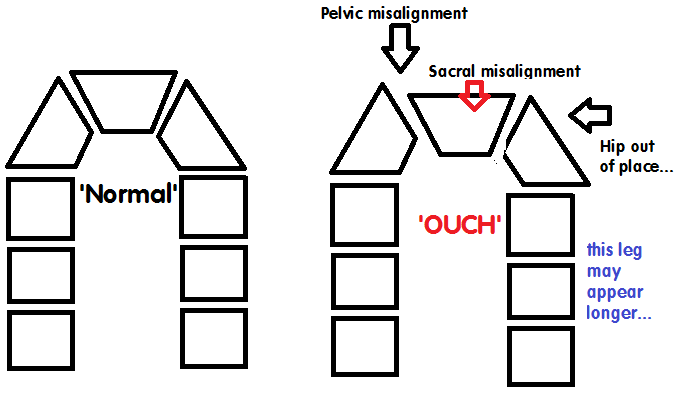
I  also drew a diagram of a very basic pelvis to see how it kinda fits together.  The diagram above is that of an arch, like in a doorway made of stone.  Notice how similar the structure is to the pelvis and lower body.  The sides of the doorway are like the legs, the key stone at the top is like the sacrum.
When a misalignment occurs, and they can occur for many reasons, such as; muscle fatigue, injury (slow or fast like a fall or sitting in a position for a long time) or even emotional stress.   The entire orientation of each part changes to try and maintain balance in the system.  This causes compensations such as muscles tightening to help or splint the area, leg length changes to accommodate the shift in the direction of the pelvis or sacrum, or re-alignment of the entire spine up to the head to adapt to the problem.
Generally, when the sacrum becomes mis-aligned the pelvis rotates and shifts, or there may be a failure of the joint and you will have lots of pain.  This pain causes spasm of some muscles and total loss of tone in others.  This can make it hard or even impossible to get out of a chair or your car.
The sacrum meets the pelvis bones at the sacro-iliac joint.  You can feel the bones of the ilium (top part of the pelvis) just below your belt line, on the back about 2" from the center of the spine (that would be at about the sacrum).  When I am confirming the alignment of the pelvis as related to leg length, that is what I use.  One of the sides is likely to be tender to pressure.
OK, so what.
This is one of the main contributors of severe back pain.  It can mimic and even confuse the most experienced practitioner (Medical Doctor, Physical Therapist, or Massage therapist) into thinking it is a disc injury.  However, once you find this kind of mis-alignment and get it to move, the pain and spasm go away.  This would not happen with a disc.  (usually)...  The sacro-iliac joint is fibrous, it is tough, in some books it is called immovable.  But I assure you it moves!  It can shift and slide out of place, even a millimeter  can cause severe pain.  It tends to move slowly, and responds better to slower adjustments with pelvic blocks.
On the right side of the arch diagram you can see where there is an arrow pointing to the pelvic misalignment. That is where the pain most likely would be felt.  That space can be swollen or compressed.  The muscles up the back and around the rump will spasm to try and splint it in place.  It really has no idea if it is broken or not, just knows it is not where it should be and will try and stabilize it as best it can.
Typical symptoms of this kind of alignment problem is pain with movement, especially getting out of bed, changing positions in bed, getting out of a car, or in one, and a feel like it just may 'give out' on you with certain movements.  Generally it feels like a 'tooth ache' feel at the sacroiliac joint or sometimes like an ice pick is stuck between the bones.  This can give you shooting sharp pain.  Usually it does not go down the leg like in sciatica.  But it will be really focal and sharp.  The muscles around it, the rump, front of thigh, and even muscles on the side of the hip can tighten.  Also my favorite muscle the Psoas can spasm, giving you that bent over Quasimodo look.
So, how does it happen?  Well, commonly it is because of a lifting issue a couple days before the pain showed up.  It can be from sitting in an odd position like when you lie on the couch and watch a movie marathon or sat in a car for a long time on a road trip.  Occasionally it is from stepping off a curve wrong or a slip and fall.  Other ways it occurs, especially if the main part is the sacrum, could be from some congenital (an anomaly you were born with) malformation.  In the furthest esoteric reasons, it could be from emotional instability related to foundation issues like home, career, stability,  family etc...
That is why it is important to look at all of the areas of possible cause; physical, chemical, and emotional before starting to go into some treatment plan.  Although it is difficult to pin down an emotional relationship, it is always a good idea to use it as an object of contemplation when going after a cause.  Many times there are insights into the reasons which really do speed up the healing and normalizing process.
The therapies I use are pelvic blocking, heat, muscle stimulation and other chiropractic adjustments and realignment techniques.  I also prescribe and teach stretching and other self care tricks of the trade to keep you 'in the saddle' as it were.
I had this very misalignment over 30 years ago when I was taking Japanese Jujitsu.  I had done a terrible barrel roll fall and really messed up my back.  The instructors there told me to do some exercises which, unfortunately made it worse.   I went to my doctor (Medical doctor) and immediately they referred me for x-rays and within a week I was being scheduled for back surgery.  Terrified, but in pain,  I purposefully missed the appointment for the surgery and figured I would just be a cripple.  Someone told me to go to a chiropractor.  My father advised me not to because they were 'quacks' and would probably paralyze me.  Well, once I became so disabled I could not manage stairs or put a pair of underwear on without sitting on the floor, I went to the chiropractor.  I am not going to say there was any miracle, the treatment was painful at first and I was afraid.  I followed the recommendations at the time, (daily for like ten days, then three times a week for a couple months, then twice a week, eventually getting down to about once a month.)  I don't use such schedules with my patients now (oh, did I mention I BECAME A CHIROPRACTOR!?)  I have found that with as little as four or five visits we can get the same result as 15 visits too close together.    It was the style at the time to have such an extensive treatment schedule, largely because my insurance paid.  LOL...
Now I work on getting people out of pain, then getting them stable and show them how to care for it themselves so that they do not have to come in as often.  Since I started practice I have had to send about five patients to surgery, but that is by far the exception to the rule with proper diagnosis and care.
Now, I use acupuncture, dry needling, chiropractic alignments, and stretching to help it get back in place and stay there.  Most patients will need follow up care, depending on how well we did initially and how they care for their backs and what kind of activities they want to stick with.  As for me, once I stabilized and strengthened I was able to do anything, including be an EMT in a major metro area, scuba dive all over the world, hike, bike, take more martial arts, and do pretty much what ever I wanted.  I know that would have not been possible if I got surgery.  Many surgeries fail, causing lasting problems and disability.  The surgery can even kill you.  I did not want to take that chance, and I was fine.
This kind of treatment is not for everyone, sometimes surgery IS the best choice.  Sometimes all it takes is time and a little stretching, sometimes a swim will help reset it.  Many times, a change in life situations can make a big difference.   For me, I was really worried about what I wanted to do with my life at the time.  I was getting student loans up the wazoo and had no plan.  It was not for almost ten years I decided to become a chiropractor, it took another ten to do acupuncture training.
If you find yourself in this predicament, go see a reasonable chiropractor.  Preferably one that does not get you on too much of a schedule.  Contact me if you want more information.   See my website http://www.thenaturalbodyworks.com or check out my YouTube Channel... thenaturalbodyworks.  I can also be reached at my office by phone or text.  720- 325 then 9886 (don't want a bunch of bots calling me)  I can advise you and help you where I can.
Hope this helped.
Dr. Sean H. Thompson, B.Sc., D.C., CCAP etc...


All ‘scripts’ can be found on our blog:  https://thenaturalbodyworks.blogspot.com


Phone: 720- 325 9886
Address:  12539 N. Highway 83, Unit B
                Parker Colorado 80134

Here is the text for the Gall Bladder cleanse, you can also see it on my blog https://drseanthompson.wordpress.com/...

The information in these videos are for education only, there is no intent to diagnose, treat or render an opinion.  Any incidental diagrams, drawings, music, video, or other recording are used under the copyright fair use for education and or satire.  Use your own brain, go see a qualified provider if there is any question…
Not responsible for you, you are.
#chiropractor
#chiropractic
#acupuncture
#acupuncturist
#health
#backpain
#migraine
#holistic
#naturalbodyworks
#instachiropractor
#subluxation

Cupping Therapy don'ts


Get the book here.

Precautions and Contraindications of Cupping Therapy:
Cupping is a therapy that can have great benefit and is relatively safe to do.  The following precautions should be followed to best avoid injury and undue pain.  This list also has contraindications for patients on whom  you should not do any cupping unless you really understand the pathology and physiology of the condition you are treating or trying to help.
  1. Hemophiliacs and those with thrombocytopenia: These people may have bleeding that will not stop, or undue bruising.  This can be more uncomfortable for them; it can possibly cause more problems, as well.

  1. Anyone who is dehydrated. You will likely find poor results, which can be frustrating.  Someone that is very dehydrated can have a good initial result.  However, cupping can cause trouble with the kidneys and make them feel temporarily worse.

  1. Skin allergies, Psoriasis, Vitiligo, eczema: You may make some of these conditions worse, at least in the short term.  Best advice is to avoid any skin that you would not consider ‘normal’.

  1. Any broken skin: Cuts, abrasions, holes, lacerations etc.  These just hurt and we never want to hurt people.  Infections or oozing areas are not a good idea either.

  1. Other skin changes: Raised moles, warts, local tumors, scabbed areas.  You can cause bleeding at these points.  When in doubt, cup elsewhere.

  1. Areas with large vessels, or lymph nodes: Arm pits (axillary), Cervical areas (the front of the neck), in the groin (inguinal), wrists, anterior of the forearm, back of the knee.  These places are usually considered too ‘Yin’ for cupping.  Some techniques can be used; we can discuss these later.  Cupping in these areas can cause severe pain and may damage the vessels or nodes.

  1. Deep vein thrombosis. Although there is little chance of causing more trouble, it is best to get a clearance from a primary provider before continuing.

  1. Genitals, nipples, lips: anywhere there is a mucous membrane. Mucous membranes are those places that open to the outside that have moisture.  Also the umbilicus (belly button).

  1. On the face. Use special technique… and really small cups…

  1. On or around the eye. This can cause exophthalmos, or an avulsion or prolapse of the tissues.  Avoid the eye area.  It would likely hurt a lot, too.

  1. On the tongue or mouth.  Although a part of a recent fad for young people, you can burst blood vessels as these are areas of very thin tissue.

  1. During the menstrual period as this can cause a disruption in the energy flow and increase discomfort, especially if many cups are used, or cupping is done near the uterus or pelvic area. This is a traditional statement really, and I have not found any significant difference in a person’s feelings after cupping.

  1. Women who are pregnant, ESPECIALLY no cupping on the pregnant belly. In fact there are areas on the ankle that are considered completely forbidden during pregnancy, as they can cause uterine contractions and therefore spontaneous abortion or delivery at the wrong time.  This point is generally not easily cupped anyway; it is located on the inner ankle about three thumb widths up from the ankle bone.  I know of no research or actual cases of this, but better to be safe than sorry.  Cupping on the shoulder and back should be fine as long as it is light and done with care.

  1. Any active disease process that weakens the person. Here, refer to comfort and get advice from an advanced provider who understands what cupping is and does.  This would include:  tuberculosis, anemia, respiratory conditions (COPD, Emphysema, Asthma), cardiovascular issues that are not under control, including hypertension and congestive heart failure.  People who suffer from these ailments may not like or do as well with stronger cupping, so use flash or light cupping.  Remember, healing is a timed process.

  1. Anyone under the age of five, (traditionally it is three years old) I have found it impossible to get one so young to sit still long enough…

  1. Bug bites, animal bites; even though you can remove the toxins or poisons, it’s best to let the body do its own work and not irritate it any more.


  1. Anywhere there are sutures or stitches. Any place there has been recent surgery.  Sometimes glue is used to close wounds.  It’s best to wait until healing is complete; a good rule of thumb is six weeks or so after the sutures have been removed.  A good idea is to check with the surgeon first.


  1. Fresh scar tissue. There are some good techniques to get scar tissue to change, but that is a bit advanced.  Using different sized cups is useful here.  Along with herbs and other salves, it can show good results.

  1. Any burn areas, new or old. A sunburn is a terrible place to have cupping.  It will aggravate the issue and the patient can have massive problems with energy flow.  This can cause fever and chills and make them susceptible to other problems.  Wait until the skin has properly healed and no sloughing of skin is occurring. With sunburn, especially sunburn that covers a large area, avoid cupping it.

  1. Other burns, if someone has scar tissue from a burn, it is best not to do cupping on those areas. The skin is no longer normal. There  are significant challenges to the way cupping would have to be applied and how the scarred skin may react.  Get an OK from the primary if possible.

  1. Someone that does not want cupping. This would include someone that is not feeling up to it or is overly skeptical.  They will tend to focus on the discomfort.  As luck would have it, that is when injury is likely to occur.  Best to wait or offer some other treatment.

  1. Someone who has over eaten, is drunk, or drank a lot the night before. You can re-distribute the toxins and make them feel more ill.  Their energy and fluids are needed to transport and help in the digestion or metabolism process.

  1. Severe fatigue:  This is an option really.  Flash cupping can help them actually feel better.  More ‘fresh’ or effervescent…   This of course depends on the type of fatigue and how much time they have for recovery.  As long as they have the proper follow up, there should not be a  real problem.

  1. The palms or soles of the feet. These areas have different skin and it can be overly irritating.   It is also difficult to get the cups to stay.

  1. After strenuous exercise. The release of that reserve energy can cause the patient  to feel even more tired and fatigued.

  1. Be cautious with people who are overly nervous or restless. Some people with severe emotional disturbance cannot tolerate the therapy and should wait until they are feeling more stable. Occasionally, people can experience sudden and sometimes disturbing emotional releases.

  1. A chronic disease process you do not understand well, including complex disorders that you should first discuss with a practitioner who understands cupping, as well as the condition of the person receiving cupping.

  1. Thin skin, very papery skin. This is common in the very old or frail and you should be cautious with this.  Ok to do lighter technique but be gentle and take time.  It may take many visits to see the desired results.

  1. People on certain medications such as Warfarin, Coumadin, have taken a lot of Aspirin, or blood thinners. People that are taking large amounts of fish oils (omegas), DHEA, Vitamin E, or Gingko Biloba.  They may have markings from cupping that will last a very long time.

  1. People that are under treatment for cancer or diabetes. Make sure you get authorization from their primary care provider.  Although there are no research articles or studies that show cupping doing any harm other than the skin discolorations in people with diabetes or cancer, most Western medical practitioners caution that somehow it can help spread the disease.  There is no basis in fact with this as people have had all sorts of other treatments that were once forbidden for cancer patients, massage being one of them.  Remember, cupping is moving fluids within the tissues.  The body’s natural response is to clean and maintain homeostasis.  The cupping treatment stimulates that to continue more vigorously, thereby removing toxins that would otherwise have a harder time being released and properly dealt with.

  1. Other areas as diagramed below. Elbows, knees, ears, feet and hands are not a real contraindication, it is just too difficult to get any cups to stay and there is little benefit from using them there.
All ‘scripts’ can be found on our blog:  https://thenaturalbodyworks.blogspot.com


Phone: 720- 325 9886
Address:  12539 N. Highway 83, Unit B
                Parker Colorado 80134

Here is the text for the Gall Bladder cleanse, you can also see it on my blog https://drseanthompson.wordpress.com/...

The information in these videos are for education only, there is no intent to diagnose, treat or render an opinion.  Any incidental diagrams, drawings, music, video, or other recording are used under the copyright fair use for education and or satire.  Use your own brain, go see a qualified provider if there is any question…
Not responsible for you, you are.

#chiropractor
#chiropractic
#acupuncture
#acupuncturist
#health
#backpain
#migraine
#holistic
#naturalbodyworks
#instachiropractor
#subluxationGet the book here.

January 2026, winter is here? Stiff, tired? I got you.

  I wanted to briefly share what I’m noticing right now, as it may help you better understand what your body is asking for. I’ve been notici...